

UP#12 Andreas Hannes

"I'm doing what I miss in the dance world."
Skipping. Who would have thought such a simple movement could be connected to so many aspects of life? Choreographer Andreas Hannes spent ten years exploring that question, and his work hasn’t gone unnoticed. His skipping anthem Anthology was awarded five stars by de Volkskrant and comes to Korzo this October. Ask Hannes about skipping and you’ll soon find yourself talking about how we stay connected in late capitalist times.
Andreas who?
Andreas Hannes is a choreographer and associate artist at Dansateliers, known for his eclectic work that explores the dynamic tension between bodies, principles, and perspectives. He has a professional background in percussion and film, and a secret love for Ariana Grande.
We meet Andreas in the kitchen of his shared home in Amsterdam.
When we enter his kitchen, he invites us to choose where to sit. We settle into the red chairs around a small wooden table, like a quiet audience. Tea steams in our glasses and dates are within easy reach. The room and his presence feel warm and inviting. It’s a feeling the audience experiences during Anthology, too. And perhaps that’s no coincidence, once you know where Andreas is from.
“I grew up in a small village in Greece where people would knock on the door of our house and come in. It’s changed a bit over the years, but social life is much more central there than it is here. The same goes for dancing. People would come to the square to celebrate and dance together. Dancing, also within my family, was a social way to express shared joy.”
Korzo’s marketing team saw Anthology during Julidans in Amsterdam and noticed the same kind of joy both during and after the performance.
“For me, dance has always been the best way to have fun, and my work is characterized by a kind of lightness. But joy is often intertwined with sadness and hard times. I think the first layer of Anthology is fun and joy, but for me, that’s just the entrance. The piece explores joy as something that can hold many things at once: pain, melancholy, being together, failing, carrying on. The dance and theater world is quite serious and dramatic. I focus on dance as something that moves me forward in a joyful way and try to create layers through that. In doing so, I’m creating the kind of dance I saw more of.”
How do you make that kind of joy tangible in the piece?
“It’s a grounded joy I’m looking for, one you can practice through hard times. During the creation process of Anthology, we investigated how far we could take things. We tested our resilience, treated it as part of the game, and looked at how we could learn from each other. We noticed that when the endless skipping became difficult, we stopped looking at each other. We became disconnected. We wanted to know: how can we stay together and support each other? How can we resist losing each other?”
That sounds very much like the fast-paced world we live in.
“Yes. It’s very much the capitalistic concept of having to keep going, keep buying, keep giving. We started making strategies: if you can’t do it anymore, someone else takes your place. But whatever we tried as a way to resist or navigate those difficult times was quickly appropriated by the system itself. In that sense, the piece is full of failed attempts.”

So Anthology has many layers, yet revolves around just one movement. What is it about skipping that makes that possible?
“Skipping is a simple double jump on one foot and then the other. It’s this state between walking and running but isn’t an instinctive fight-or-flight response. It’s an in-between state of enjoying the movement through time and space, not driven by an outcome but driven by emotion: the fun of exploring gravity and the playfulness of life. What I like is its multiplicity: It’s a way to navigate space, to be firm, and to know where you’re going. At the same time, skipping just sort of happens.”
What did skipping reveal to you that you didn’t expect?
“I did a test working with different groups of dancers and I asked them how they would teach someone else to skip. The most common answer was to take the other person’s hand and find the rhythm together. Then the other person would realize: hey, I know this. This is how skipping becomes fundamental in the way that it’s not only transferring knowledge, like parents do with kids, but also the body requires it as one more skill to be developed; a way of testing the limits of gravity.”
I think we've forgotten what dance is in the theatre.
Anthology is the headline performance during Korzo’s ‘No Lonely Dance Floors’. Earlier, you talked about connectedness and going through something together. How can dance floors bring people together in a different way?
“I have friends that I met on the dance floor and I used to dance in a small bar in Amsterdam called Reality, where very different people would meet each other through dance. There wasn’t much space, so you’d find yourself dancing with someone you might not otherwise have danced with. But the dance floor is also a place where I could move my body freely in a public space, and that would attract others. Someone likes how you dance and suddenly there’s a connection! The club has this glorious combination of lights, night, people, and expectations. But I think we’ve forgotten what dance is in the theatre.”

What exactly did we forget?
“I’m speaking very generally now, but I always thought of the theatre as a place you enter to be inspired before going back out into the world. But the capacity and magic of dance is a bit lost. Freedom of dance, freedom of movement is very restricted in the theatre because of the belief that it should look a certain way. And that belief also affects how the audience reacts. In Anthology, you can scream, shout, dance, and show your support. We invite you to react in any way that feels natural.”
To end on the subject of joy: what gives you hope in times like these?
“Being in nature, looking at the mountains for example, can give you a different perspective on life. And while the universe can be hostile, it also operates through togetherness and relationships. Hope is easier to feel when someone else is there. Because hope is always within us, as the future of the present moment.”
Anthology is in Korzo from 15 till 24 October 2026
Get your tickets
* Wear the story
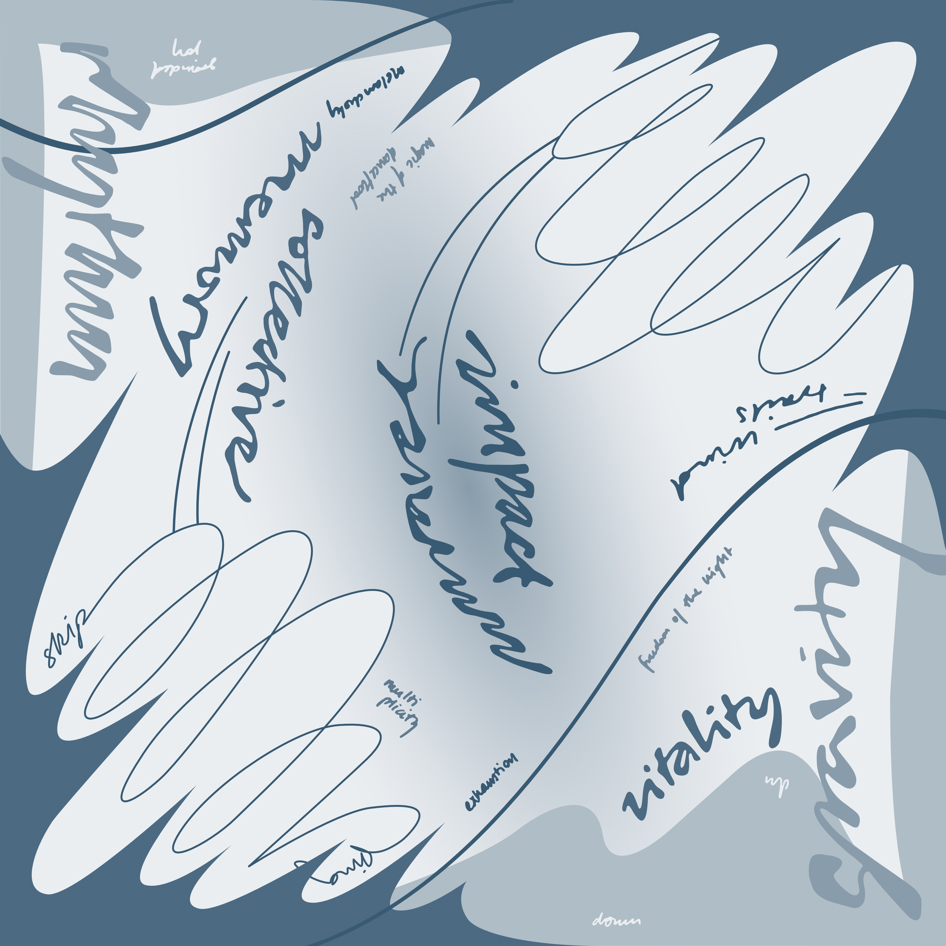
For each Korzo UP interview, visual designer Carmen Daxler creates a unique Calliographic Recording. This edition captures the essence, movement and emotion of the conversation with choreographer Andreas Hannes.
The design is hand screen-printed onto 100% cotton at the Grafische Werkplaats in The Hague. Only 15 scarves are made.
€65
Available at Korzo front desk.
Bekijk ook

Korzo start Protestkoor
Ben jij een (potentiële) zangvogel en kan je niet langer stilblijven?Korzo start Het Haagse Protestkoor: een nieuw koor voor Haagse zangvogels die iets te zeggen hebben. Onder leiding van...
Verder lezen
UP #11 Alistair Sung
Sounds from a world yet to comeAs a teenager, Alistair Sung walked through the scorching Australian sun to his first cello lessons, carrying an instrument that was almost bigger than himself. Years...
Verder lezen